The young blue jays are back -- I think there are about 3 or 4 of them. They've been crashing through the trees, screeching from branch to branch, as they follow each other. They already look very much like the adults, although their backs are still somewhat gray.
But the big give-away to their "juvie" status is their begging.
This one had figured out the suet feeder and was doing quite well, until he decided that he might get catered to if he hollered and begged for awhile.
When he didn't get any response, he went tearing off across the road with the rest of his siblings.
Showing posts with label New Hampshire. Show all posts
Tuesday, June 29, 2010
Tuesday, February 16, 2010
Hampton Skies
We're enjoying the winter skies at the beach in Hampton, NH.
On Monday morning, I walked across the street for this view over the ocean toward the Isles of Shoals.
And this was our view looking out back over the saltmarsh.
Coming back from Portsmouth on Monday afternoon, the cloud patterns along the coast were striking.
This morning, from our front balcony, the sun was shining through the clouds, reflecting on the water and sand below.
And now this afternoon, the snow is blowing sideways, the waves are crashing against the seawall, and we're toasty warm inside watching Mother Nature.
Wednesday, September 9, 2009
Early Morning at the Beach
An early morning walk along the beach
at the north end of Hampton
yielded some interesting colors and patterns
as the sun rose and the tide was going out.
Wednesday, May 20, 2009
I must go down to the seas again
When I was in junior high, our English teacher had us memorize a new poem each week. And one of those came back to me the other day. Do you remember John Masefield's poem Sea-Fever, especially the beginning of the second stanza?
"I must go down to the seas again, for the call of the running tide
Is a wild call and a clear call that may not be denied;"
Two days ago, I did just that -- went down to the sea again, with local high school science students. Every year a group of biology and environmental science students from Plymouth Regional High School go to Odiorne Point State Park (near Portsmouth) for an all-day working field trip. I've helped chaperone this trip for several years while I was librarian at the high school -- there were actually two of us who came out of retirement to help again this year.
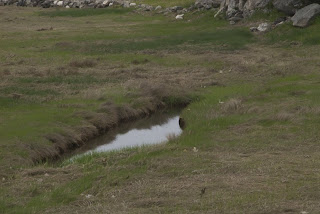
Odiorne Point State Park is the last undeveloped section of shoreline in New Hampshire, is the site of the first New Hampshire settlement in 1623, and served an important military role during World War II. The salt marsh area was very important for the early settlers, who harvested the marsh hay every year. And the area was also part of the Portsmouth harbor defense during World War II; the camouflaged concrete gun casements and gun mounts are still visible.
But the varied natural habitats of Odiorne Point were the primary focus of our trip on Monday -- the salt marsh, the estuaries, and the rocky shore. The students recorded water temperatures and water density; they collected and examined organisms with a seine net (and, of course, returned all the organisms to the water).
Each group ran a transect line from the top of the rocky beach down to the water edge -- they measured and mapped elevation changes along the line, measured tidal changes as the tide came in, collected plankton samples, recorded organism identification and quantities at measured points along their transect line. All this (and even more) data will be analyzed in the classroom when they get back to school.
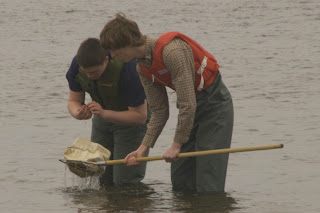
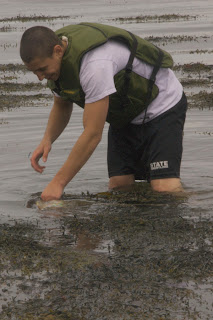
The day was a lot of fun and the weather was perfect. Hats off to all the students, who were prepared and worked well together. And hats off to the hard-working teachers and aides who plan and run this valuable hands-on educational experience!!
"I must go down to the seas again, for the call of the running tide
Is a wild call and a clear call that may not be denied;"
Two days ago, I did just that -- went down to the sea again, with local high school science students. Every year a group of biology and environmental science students from Plymouth Regional High School go to Odiorne Point State Park (near Portsmouth) for an all-day working field trip. I've helped chaperone this trip for several years while I was librarian at the high school -- there were actually two of us who came out of retirement to help again this year.
Odiorne Point State Park is the last undeveloped section of shoreline in New Hampshire, is the site of the first New Hampshire settlement in 1623, and served an important military role during World War II. The salt marsh area was very important for the early settlers, who harvested the marsh hay every year. And the area was also part of the Portsmouth harbor defense during World War II; the camouflaged concrete gun casements and gun mounts are still visible.
But the varied natural habitats of Odiorne Point were the primary focus of our trip on Monday -- the salt marsh, the estuaries, and the rocky shore. The students recorded water temperatures and water density; they collected and examined organisms with a seine net (and, of course, returned all the organisms to the water).Each group ran a transect line from the top of the rocky beach down to the water edge -- they measured and mapped elevation changes along the line, measured tidal changes as the tide came in, collected plankton samples, recorded organism identification and quantities at measured points along their transect line. All this (and even more) data will be analyzed in the classroom when they get back to school.

The day was a lot of fun and the weather was perfect. Hats off to all the students, who were prepared and worked well together. And hats off to the hard-working teachers and aides who plan and run this valuable hands-on educational experience!!
Friday, April 17, 2009
Why does the grouse cross the road?
For the same reason that the chicken does, it seems . . . to get to the other side.
We had just left the house the other day when we saw a quail-like bird crossing the road in front of us. And when we drove back through about an hour later, we saw the same bird slowly crossing the road the other way. What gives?
So as soon as we got home, I walked back up with my camera. And sure enough, the bird was still there, just standing under a tree in front of the corner house. It let me get within a couple feet of it and even started walking toward me as I was taking pictures. It seemed very content to be there, but I backed off, not wanting to startle it.


This was another first for me -- a ruffed grouse. And as I was reading several descriptions on web sites, I found a few that said that sometimes they will seem "tame" if they have not been around agressive predators a great deal.
The spring days are warming up, and so are the feeders. The pine siskins are fighting for the available spots on the feeders, so I spread some seed on the deck railing . . . and pretty soon that was busy, too.

We had just left the house the other day when we saw a quail-like bird crossing the road in front of us. And when we drove back through about an hour later, we saw the same bird slowly crossing the road the other way. What gives?
So as soon as we got home, I walked back up with my camera. And sure enough, the bird was still there, just standing under a tree in front of the corner house. It let me get within a couple feet of it and even started walking toward me as I was taking pictures. It seemed very content to be there, but I backed off, not wanting to startle it.


This was another first for me -- a ruffed grouse. And as I was reading several descriptions on web sites, I found a few that said that sometimes they will seem "tame" if they have not been around agressive predators a great deal.
The spring days are warming up, and so are the feeders. The pine siskins are fighting for the available spots on the feeders, so I spread some seed on the deck railing . . . and pretty soon that was busy, too.

Thursday, March 19, 2009
Doing Spirals
Tuesday, March 17, 2009
Signs of Spring -- and another first

I'm finally beginning to believe that spring really is on the way. There is still plenty of snow on the ground in our area, but winter is slowly fading away. The snow banks along the roads are dirty, the potholes are growing, the mud is overtaking the back roads, and the annual "Frost Heaves" signs are sprouting like weeds.
As the temperatures gradually inch up and the days lengthen, the bird population is changing, too. The flocks of goldfinches are larger, the chickadees are noisier, and the blue jays are back with their bossy voices.

While I've had a few white-breasted nuthatches all winter, I've suddenly been getting a lot of the smaller red-breasted nuthatches. They do a fast grab and run at the sunflower chips, but stay much longer on the suet feeder. As fast as they are, they've been easier to get photos of than the larger white-breasted nuthatch.
This winter I've also added a few "firsts" to my bird life list. About three weeks ago I had a white-winged crossbill under my feeders. Yesterday, I had a LBJ (little brown jobby) with reddish chest up in the tree watching me for quite awhile. But it wasn't the usual house finch or purple finch. First I had a male common redpoll, then later a female staring at me from the branch.Then, all of a sudden, I had about half a dozen common redpolls under the feeder.
So, while winter probably hasn't had its last hurrah, signs of spring are here.P.S. -- Did you look up last night and see the space station and shuttle overhead? It was a perfectly clear night and amazing to see how fast it seemed to move across the sky.
Tuesday, February 24, 2009
From Winona to Waukewan

Winona Road is one of New Hampshire's back roads -- a picturesque route between Ashland, Center Harbor and Meredith. This view is from a little bridge over the connection between two lakes, looking at Lake Winona from its southern end.
It was a cold February morning -- the skies were beginning to brighten, but the cold had left a thin layer of frost on all the bare branches along the lakes.Looking the other direction from the bridge, the water flows out of Lake Winona into what eventually becomes Lake Waukewan.
Monday, February 23, 2009
It's been a long time . . .
. . . since I've put anything up (2-1/2 months long)! So to start catching up, I'll post a couple photographs from this last week.
The other day, when I glanced out the window, I saw a goldfinch on the ground -- just one, unlike the flocks of sometimes thirty or forty that I've been seeing lately. But when I took a closer look, I realized it wasn't a goldfinch, although there was a greenish-yellow tint to it. It was actually a little larger and the other markings weren't right.
I went outside to get some photos of it and was surprised that it actually let me get about four feet from it without flying away.


After I pulled out the trusty bird ID guide, I determined it was a female White-Winged Crossbill (Loxia leucoptera). I have seen it a few other days, too, always alone and feeding from the ground. This is one to add to my list.
The other day, when I glanced out the window, I saw a goldfinch on the ground -- just one, unlike the flocks of sometimes thirty or forty that I've been seeing lately. But when I took a closer look, I realized it wasn't a goldfinch, although there was a greenish-yellow tint to it. It was actually a little larger and the other markings weren't right.
I went outside to get some photos of it and was surprised that it actually let me get about four feet from it without flying away.


After I pulled out the trusty bird ID guide, I determined it was a female White-Winged Crossbill (Loxia leucoptera). I have seen it a few other days, too, always alone and feeding from the ground. This is one to add to my list.
Tuesday, November 18, 2008
Sunrise and chasing the waves
We make frequent visits to a friend in Hampton, NH. From the balcony of his condo on the first day of September, we had a great view of the gorgeous sunrise over the beach (and of course the utility wires -- pretend they're not there).And then later in the day, as the light was fading, I took a walk along the beach. There were a few other people out there, some with their dogs, just quietly strolling along.
But parts of the beach were quite busy. The semipalmated plovers
and the sanderlings were chasing the waves and finding all those yummy little invertebrates in the wet sand.
The light reflecting off the wet sand made some interesting patterns.
Labels:
beach,
birds,
Hampton,
New Hampshire,
sanderling,
semipalmated plover
Monday, October 27, 2008
Monday, September 22, 2008
First Day of Fall
Today is the first day of fall (it was official at 11:44 AM EDT) -- the most colorful season here in New Hampshire. I have already seen some leaves beginning to change color -- as you look at the mountains and along the roads, you can see random spots of yellow or red among the green trees. Here are a couple pictures of the early changes from another year.
This photograph was taken two years ago, almost to the day, along Meredith Center Road, from the shore of Wickwas Lake on a foggy morning.
And this view is the Merrymeeting Marsh area, at the boat launch along Route 11. We drove by there Sunday morning on our way down to Portsmouth and it looked almost the same as two years ago.
So now I just have to watch for more of the colors to come out over the next few weeks.
This photograph was taken two years ago, almost to the day, along Meredith Center Road, from the shore of Wickwas Lake on a foggy morning.
And this view is the Merrymeeting Marsh area, at the boat launch along Route 11. We drove by there Sunday morning on our way down to Portsmouth and it looked almost the same as two years ago.So now I just have to watch for more of the colors to come out over the next few weeks.
Tuesday, September 2, 2008
Hampton on Labor Day
We spent the weekend with a friend who lives in Hampton, New Hampshire. This was the sunrise over the ocean on Labor Day morning.
A short time later, I took a walk along the beach and found these Semipalmated Sandpipers and Semipalmated Plovers were also out for a walk.

The sandpipers were the hardest to get photos of in the early morning light -- they are very fast as they skitter across the wet sand, not even pausing very long when they find something.
The plovers were just as fast, but for some reason I had a little more luck with them.

A short time later, I took a walk along the beach and found these Semipalmated Sandpipers and Semipalmated Plovers were also out for a walk.

The sandpipers were the hardest to get photos of in the early morning light -- they are very fast as they skitter across the wet sand, not even pausing very long when they find something.The plovers were just as fast, but for some reason I had a little more luck with them.


Subscribe to:
Posts (Atom)